
The records.
A checklist for preserving and organizing your own records when your writing has been questioned. It does not determine which policy governs a case, calculate deadlines, or recommend arguments; it covers what to keep and how to arrange it so that anyone reviewing it — including an adviser of your choosing — can follow it. If an outcome could affect enrollment, immigration status, a degree, professional licensing, or accommodations, consider obtaining qualified advice before responding.
- Save what was received
Keep the notice and anything the institution provided, exactly as received: emails, attachments, the score or report if one was shared, and the date each item arrived.
- Preserve drafts and version history, without modifying originals
Leave the original closed. Reopening a cloud document can add revisions of its own, and any edit made after a notice arrives clouds the cleanest fact in the file — that it has not been altered since submission. Then, working from copies: Google Docs, File → Version history; capture the timeline and a scroll-through of named versions showing dates and word counts. Word and OneDrive: Version History from the title bar, plus AutoRecover files. Keep outlines, notes, photographs of handwritten material, and contemporaneous messages about the assignment. Duplicate all of it to two locations the same day; platform version histories are subject to retention limits and can be altered by subsequent edits.
- Note who else saw the work happen
A writing center appointment, a librarian consultation, an instructor's comments on an earlier draft, a classmate who read a paragraph, a tutoring log, a calendar entry made at the time. People and systems that observed the work independently are part of the record, and their traces — confirmation emails, appointment histories, comment threads — are easy to retrieve now and hard to reconstruct months later.
- Locate potentially relevant official sources
The academic-integrity policy, the student handbook, and the course syllabus are the usual places institutions state how such matters proceed. These are potentially relevant sources, not a determination of which one governs; confirm applicability with the institution. Any dates they contain are quoted from the source, not a deadline calculation.
- Arrange the records chronologically
One chronological PDF behind an exhibit list: assignment date, outline, each draft stage with date and word count, final submission. A useful standard: a reader unfamiliar with the situation can follow the document's development in two minutes. Early drafts belong in the record precisely because they are rough; development over time is what the records show.
- Note the questions you want answered
Keep a running list, in your own words, of what you want to understand about the process and the concern raised. Bring it to any meeting; a written list survives a stressful conversation better than memory does.
- Seek qualified assistance when consequences may be substantial
If an outcome could affect enrollment, immigration status, a degree, professional licensing, or accommodations, consider obtaining qualified advice before responding. An organized set of records makes that assistance faster and cheaper wherever you find it.
What to do with your school's published pages
The institution pages quote what a school has published about AI detection and academic integrity. The checklist above covers your own records. These are the places the two meet.
- Capture the pages as they read today
Institutions revise these pages, sometimes while a matter is open. Save each relevant page as a PDF with its URL and the date of capture visible, the same way you preserved your drafts. A capture requested at web.archive.org/save also puts a dated copy in third-party hands — held by neither you nor the institution, which is what makes it worth the minute it takes. Every quotation on this site carries a retrieval date for the same reason.
- Record what the sources say about time, and what actually happened
Published procedures often state periods in their own words: a number of days to make contact, to respond, to appeal. Copy those statements as quoted, and keep your own dated list beside them — when notice arrived, when a meeting was held, when a letter came. That is a chronology, not a calculation. How any stated period applies to a particular situation is for the institution and its process to determine, and asking the office directly is how that gets settled.
- Ask what was found, in writing
Published procedures frequently state that a student is entitled to know what was found — the report, the score, the passages at issue. Whether yours says so is on your school's page, quoted from its own documents. A request put in writing produces a dated record whether or not it is answered, and whatever comes back belongs in the same file as everything else.
- Read the syllabus next to the policy
Many institutions leave AI rules to individual instructors and say so on their own pages. Where that is the case, the syllabus and the assignment instructions are among the documents that matter, and they belong in your source list with retrieval dates of their own.
- Keep a record of the process itself
Dates and times of meetings, who was present, what was offered — some published procedures mention a note-taker or the option to record — and every email kept as received. If a question about how the process was conducted comes up later, that record is what an adviser, an ombuds office, or an attorney would need in order to evaluate it. Whether a departure from a published procedure matters, and what can follow from it, is a judgment for someone qualified to make it. This site does not make it, and no packet does either.
The transmittal note
A factual cover note for a records packet. It asserts only what its author chooses to state and what the packet attaches; edit everything.
The evidence packet
Eight documents that turn a folder of files into a packet a stranger can follow in two minutes.
The checklist above tells you what to keep. This is the shape to put it in. Each row is a format decision you would otherwise be making yourself, in the week you can least spare the hours — so here they are, made, for you to copy or ignore.
| Document | What it does |
|---|---|
| How to use | The order of assembly, down to how the final PDF is stacked |
| Cover sheet | Who assembled the packet, for what assignment, spanning what dates |
| Exhibit index | Every enclosed item, lettered and dated |
| Chronology | The work in calendar order, keyed to the exhibits |
| Caption sheets | One per exhibit: where the original lives, how this copy was made, whether the original is unaltered, what was redacted |
| Source list | The official documents you consulted, with retrieval dates |
| Redaction checklist | Eight things screenshots leak without anyone meaning to — classmates' names, open tabs, financial and health detail, credentials |
| Transmittal note | The factual cover letter above, editable |
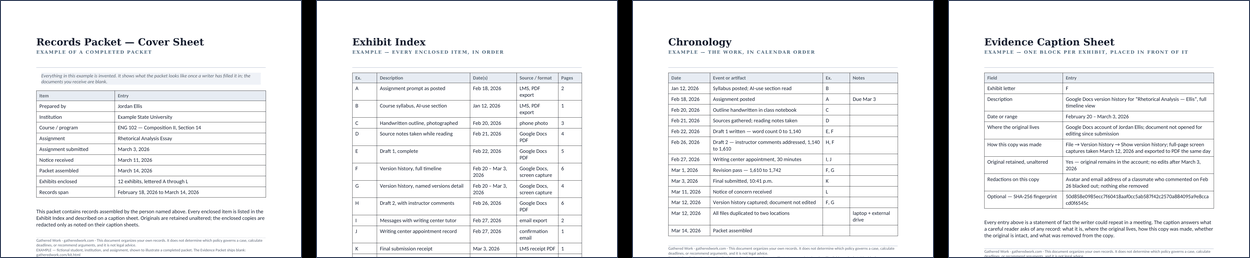
What a finished packet looks like
Four pages of a completed example: the cover sheet, an index of twelve lettered exhibits, the chronology they key into, and one caption sheet filled in. Fictional throughout — a model to build your own from, not a form to fill in.
A packet in this shape does not identify which policy governs your case, calculate deadlines, or recommend arguments; it contains no appeal or hearing materials, and it makes no claim about what any of it will achieve. The records are yours, and the argument, if there is one, stays yours. Where enrollment, immigration status, a degree, professional licensing, or accommodations could be affected, consider qualified advice before responding — an organized packet sends that hour to the matter instead of to sorting files.
Once the exhibits are redacted and named, the assembler will stack them into a single paginated PDF — transmittal note, cover sheet, index, chronology, and a caption sheet in front of every exhibit. It runs in your browser and receives nothing, the same way the vault hasher does.